

CAIM Certifed AI Manager Manchester UK

PECB Accredited Certification

EXAMPLE IASSC SIX SIGMA CERTIFICATION GREEN BELT EXAM QUESTIONS.

NOTE THAT THE ACTUAL IASSC EXAM CONTAINS 100 QUESTIONS AND MUST BE COMPLETED AS A CLOSED-BOOK EXAM WITHIN 3 HOURS. TRY TO COMPLETE THE 13 QUESTIONS BELOW IN LESS THAN 20 MINUTES. ( Answers shown at the bottom of this page )

20 MINUTES

Sample Test Questions
(Select all applicable answers)

1. A Green Belt is attempting to improve the customer experience provided by a call centre for a budget airline ( telephone support). As a result he should build a list of Critical to Quality Characteristics based on ____________________.

a. Service benefits defined by customers
b. Product features requested by customers
c. Cost of production
d. Size of unit
e. The Voice of the Business

2. A dairy learned through a Lean Six Sigma project their ice cream products could be stored at a temperature 2 degrees higher than they had historically used. Since their energy costs for ice cream storage cost $6,000 per month per degree of temperature, what was reported as the annual savings from this LSS project?

a. $72,000
b. $144,000
c. $432,000
d. $720,000
e. $12,000

3. Producing more than is needed by the next step in the process or more than the customer needs is an example of which of the Seven Elements of Waste?

a. Overproduction
b. Correction (defects)
c. Inventory
d. Motion
e. Waiting

4. An FMEA is an important tool for a Black Belt. From the list below select the three items that best describe the benefits obtained from constructing a FMEA.

a. Predict where/when/how failures may occur
b. Estimate the severity, occurrence and detection of defects
c. Helps display the procedural order of a process
d. Identify ways in which a process can fail to meet customer requirements
e. Identify which 20 % of causes of defects are responible for approx 80% of all defects

5. The shape of a Normal Distribution is impacted primarily by:

a. Sample Error
b. Mean
c. Data Type
d. The standard deviation or variance of the data distribution
e. Median

6. Since 95% of Normally Distributed data is within +/- 2 Standard Deviations of the Mean, then the probability is _____% that a sample Mean is within +/- 2 Standard Deviations of the population Mean.

a. 30
b. 47.5
c. 75
d. 95

7. After running some statistical tests, a Belt found that the P-value was greater then 0.05 which indicated:

a. There is a difference or relationship with at least 95% confidence
b. There is no difference or relationship with at least 95% confidence
c. To reject the Null Hypothesis with a least 95% confidence
d. To run five more tests to get 95% confidence
e. To change the Null Hypothesis

8. A wine distributor hypothesizes that sales average $12,000 per month. A sample report of 10 months with a Mean of $11,277 was selected. The Standard Deviation is $3,772. Using an alpha of 5 percent, is the distributor statistically confident? What are the correct Degrees of Freedom if doing the t-test?

a. 1
b. 9
c. 10
d. 11

9. Which two statements are correct for the Regression Analysis displayed above?

a. The dependent variable is Personnel hours
b. The independent variable is “Tons mined.”
c. The regression is statistically insignificant as the R2 value is < 80 %.
d. The dependent variable is “Tons mined.”
e. The input “Personnel hours” has an impact on “Tons mined.”

10. Which of the following statements is false of the Pareto Chart Effects diagram output hown by Minitab above?

a. There are 5 factors varied in this experimental effort.
b. Factor “B” has the highest effect on the output measured in this experiment.
c. Three-Way interaction effects have a significant effect on the output.
d. Factor “C” has the lowest main effect on the output measured in this experiment.
e. Two-Way interactions and Main effects are to be pursued in further trials.

11. Which item is the least descriptive of a properly designed control system using the Lean toolbox?

a. Balanced and consistent work flow across a process
b. Zero inventory of Work In Process (WIP)
c. Tidy, organized and maintained office equipment or machinery
d. Labeled inventory areas which control the production of material or services

12. A characteristic of properly executed SPC includes which of the following (Select two answers):

a. Immediate response to an out of control indication
b. After a action to an out of control indication of violating the 3 sigma limits, the next data point is just within the 3 sigma limits so another action was taken to further reduce the response
c. Plotting the response from the process at the end of the day and then analyzing for out of control conditions and taking actions if still out of control
d. Creation of Out of Control Action Plans before using an SPC Chart in the process

13. If unsustained results are the case after project closure, what actions should be taken to recapture the benefits of the Six Sigma project?

a. Contact the Belt no matter where he/she is
b. Contact the Belt if still in the same process area
c. Reference the Control Plans and key finding in the final report
d. Check to see if the SPC Charts are up to date
1.A. Service benefits
2.B. $144,000
3.A. Overproduction
4.A. Predict where/when/how failures may occur
B. Estimate the severity, occurrence and detection of defects
D. Identify ways in which a process can fail to meet customer requirements
5. D. The Standard Deviation or Variance of the data Distribution
6. D. 95%
7. B. There is no difference or relationship with at least 95% confidence
8. B. Sample n=10 dF= n-1 =9
9. D. The dependent variable is “Tons mined”
E. The input “Personnel hours” has an impact on “Tons mined.”
10. C. Three-Way interaction effects have a significant effect on the output. ( is incorrect)
11. B Zero inventory of Work In Process (WIP)
12. A. Immediate response to an out of control indication
D. Creation of Out of Control Action Plans before using an SPC Chart in the process
13. C. Reference the Control Plans and key finding in the final report

For Black Belt exam questions you can try this independent 3rd party website with 40 Black Belt Questions and Answers;

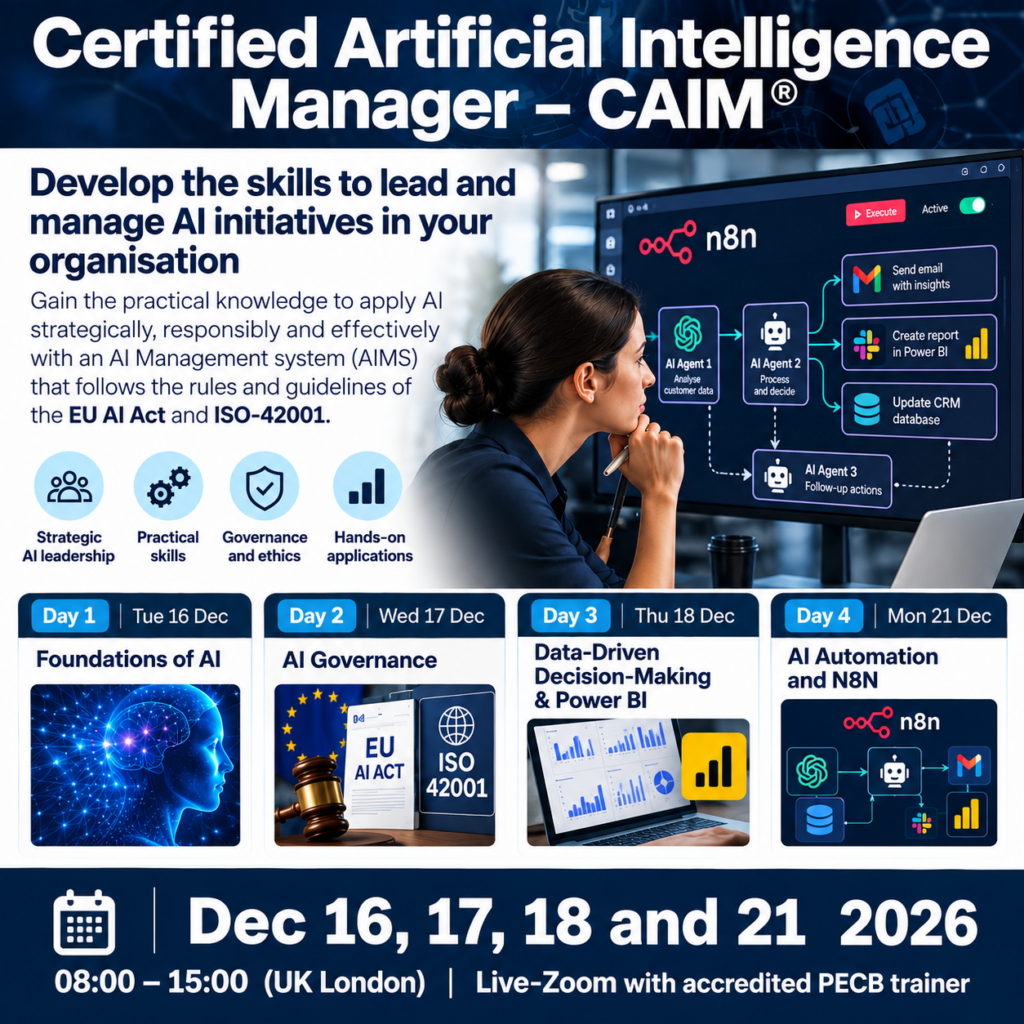
4-day Live-Zoom + Exam

AI Certification Manager Course CAIM PECB UK

December 16,17,18 and 21 2026 : Accredited UK Based trainer

The Certified Artificial Intelligence Manager training course enables participants to acquire the necessary expertise to manage, govern, and implement AI strategies successfully within an organization.

This course provides the essential framework for leaders to bridge the gap between complex technology and strategic business goals. It includes a broad range of domains from foundational AI concepts and global trends to advanced applications like data-driven decision-making with Power BI and workflow automation using AI agents. 

It also emphasizes responsible AI governance, including risk management, transparency, and compliance, ensuring participants are well prepared to oversee AI projects that deliver real business value.

Importantly, this course focuses on utilizing intuitive, visual platforms, allowing professionals to implement powerful solutions without the need for technical programming expertise.

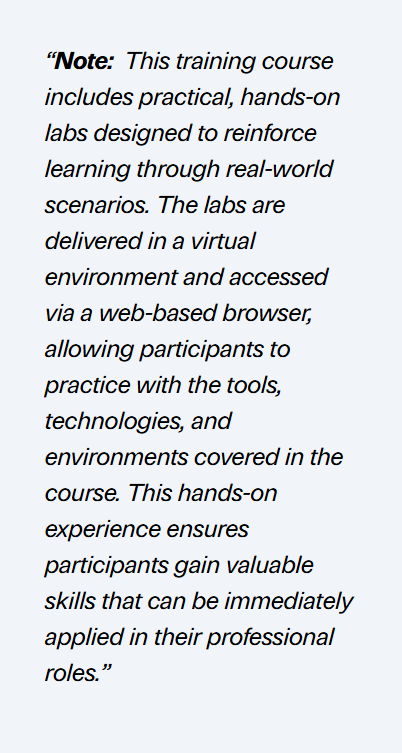
NOTE for CAIM PECB Live Zoom

Why Should You Attend?


In today’s rapidly evolving AI-driven world, the ability to manage AI initiatives is a critical leadership skill. The Certified Artificial Intelligence Manager course is your gateway to turning AI’s technical potential into governed, measurable business results. This training moves beyond high-level strategy by equipping you with practical governance frameworks and hands-on skills to plan, monitor, and automate AI solutions effectively.

Throughout this program, you will gain hands-on experience with the complete AI life cycle using accessible, no-code environments. You will learn how to assess data readiness, govern AI systems with fairness, transparency, and risk awareness, and tell compelling stories with data using Power BI. You will also explore cutting-edge automation by building AI agents through visual interfaces such as n8n. This approach allows you to focus on logic, strategy, and business outcomes rather than writing code.

After attending the training course, you can take the exam. If you pass, you can apply for the “Certified Artificial Intelligence Manager” credential. Attaining this credential demonstrates your capability to lead with confidence. This distinction confirms your competence to align AI projects with company goals, interpret complex results through interactive dashboards, and ensure compliance with evolving regulations and internal policies.

Whether you are a project manager, business director, or compliance officer, this course will empower you to:

Align AI strategies with organizational objectives to maximize ROI
Govern AI projects by mitigating risks, ensuring fairness, and maintaining compliance
Visualize performance metrics using interactive Power BI dashboards for better decision-making
Automate routine workflows by designing and deploying AI agents through user-friendly interfaces
By joining this course, you are taking a significant step toward becoming a trusted authority in AI management and ensuring your organization harnesses the power of AI safely, effectively, and in line with its strategic goals.

Prerequisites
There are no formal prerequisites for this training course. A general familiarity with business processes, data, or digital tools is helpful but not required.

Who Should Attend ?

Educational Approach

Educational Approach
The course combines strategic concepts with practical application to ensure participants master both the “why” and the “how” of AI management.


Hands-on labs and workshops use visual, drag-and-drop environments so participants can build Power BI dashboards and n8n automation flows immediately, without writing code.
Participants are strongly encouraged to interact with one another, exchange ideas, and actively participate in discussions.


PECB offers various training course delivery formats, from traditional classroom settings to modern, technology-driven solutions. To learn more about these formats, please click here.

Learning Objectives

This training course is intended for:

AI project and product managers who are responsible for planning and delivering AI in.tiatives, need to strengthen their governance skills, and communicate outcomes clearly to stakeholders


Business leaders and program directors (including transformation leaders, COOs, and department directors) who oversee AI initiatives across cross-functional teams and must ensure that technology investments support business objectives


Risk, compliance, and governance officers who review AI use cases, handle AI risk assessments and transparency reports, and ensure that the organization complies with ethical guidelines, internal policies, and external regulations


Team leaders and managers in key industries (such as health care, finance, manufacturing, and public services) who work with vendors and internal teams to ensure that AI solutions deliver tangible measurable value
IT managers, consultants, and digital transformation professionals moving into AI leadership roles who require a comprehensive understanding of AI strategy, data readiness, governance, and automation tools

By the end of this training course, participants will be able to:

Explain how AI governance, leadership, and risk management intersect, and apply the findings to support compliant and responsible operations


Align AI initiatives with organizational goals and stakeholder requirements in a strategic way to ensure clear ownership and measurable outcomes


Evaluate and prioritize AI opportunities using simple assessment tools to identify high-value, feasible projects
Design and implement interactive dashboards in Power BI


Create automated workflows by building and orchestrating AI agents directly in n8n to increase operational efficiency and consistency


Develop a structured communication and change management plan to support smooth AI adoption across teams and functions