
CAIM Certifed AI Manager Manchester UK

PECB Accredited Certification

EXAMPLES OF EXAM QUESTIONS

Examples of Lean Six-Sigma Black Belt course Material :

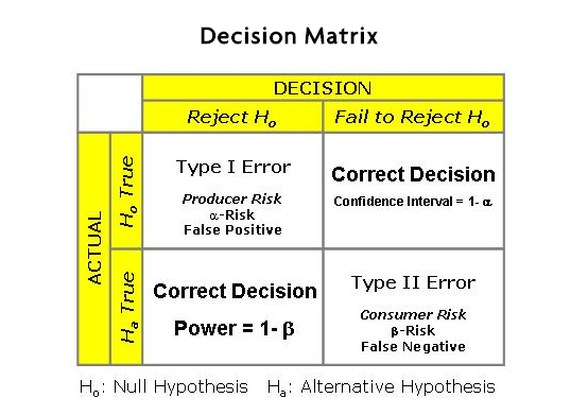
dession-matrix
Hypothesis Testing, Type 1 and Type 2 errors, Alpha-risk, Beta-risk, Confidence Interval, Confidence Level, Power of Statistical Tests.

What are producer and consumer

Alpha risk is the risk of incorrectly deciding to reject the null hypothesis. If the confidence interval is 95%, then the alpha risk is 5% or 0.05.

Alpha error is also called False Positive, Producer Risk or Type 1 Error.
Confidence Level = 1 – Alpha

If not otherwise stated then an Alpha risk of 0.05 is assumed, making the confidence level = 95%.

Selecting an Alpha 5% signifies that there is a 5% chance that you were incorrect in rejecting the Null hypothesis.
It’s the amount of risk you are willing to accept of making a Type I error.

Beta risk is the risk that you decide to accept the Null Hypothesis when in fact the reality is that the Alternative Hypothesis is true. In other words, when the decision is made that a difference does not exist when there actually is.

If the power desired is 90% that your testing will correctly identify the Alternative when the Alternative is correct, then the Beta risk is 10%.

The Beta risk being 10% means that there is a 10% chance that the decision will be made that there is no problem, and no action needs to be taken, when in reality there is a problem and some action does need to be taken. Or when the decision is made that a difference does not exist when there actually is a difference.

The Power of a test = 1 – Beta

Beta error is also called False Negative and Type II Error.

The Power is the probability of correctly rejecting the Null Hypothesis.

The Null Hypothesis is technically never proven true. It is “failed to reject” or “rejected”.

“Failed to reject” does not mean accept the null hypothesis since it is established only to be proven false by testing the sample of data.

Consumer’s risk = β = Beta Risk.

Type II error is known as the consumer’s risk because the consumer has accepted a shipment that should be rejected. The shipment contains more than an acceptable number of defectives and will result in more waste or rework than anticipated.

Producer’s risk, α = Alpha Risk

Type I error is referred to as the producer’s risk because the producer made a good lot yet it was rejected.

An operating characteristic curve (OC curve) quantifies these risks on a graph that lets you choose the appropriate sampling plan for the risks you are willing to accept.

2. Use of Takt Time and Cycle Time to calculate number of workers required


TAKT TIME VS CYCLE TIME

Thank you to Lean6Sigma4all and Daniele Giambra for sharing these excellent examples:

Method to calculate the Number of Resources / Workers needed

There could be 2 misunderstandings about how to calculate the Number of Resources that are needed to run a production line or manufacturing cell.

When you implement standard work you have to consider that a Takt Time (TT) is based on customer demand must first be established for the area in question, for example 30 seconds TT, this is equal to set a rate of 120 UPH (Units per Hour).

Therefore; the next question is how many workers are needed in the manufacturing area at this rate?

The answer depends on the total LABOR CONTENT in the area and its relation to demand (TT).
It’s also known as graph of “Takt Time vs Manual Cycle Time”, in many industries.
The more work content, the greater the number of workers that will be required; the less overall work content, the fewer workers that are needed.

Misunderstanding 1:

I have found there is a misunderstanding of Overall Work Content, many people take the Cycle Time complete (Machine + Manual) wich is not right, they must use the “Manual” Overall Work Content (Total Manual Cycle Time)

Here is a PRACTICAL EXAMPLE:
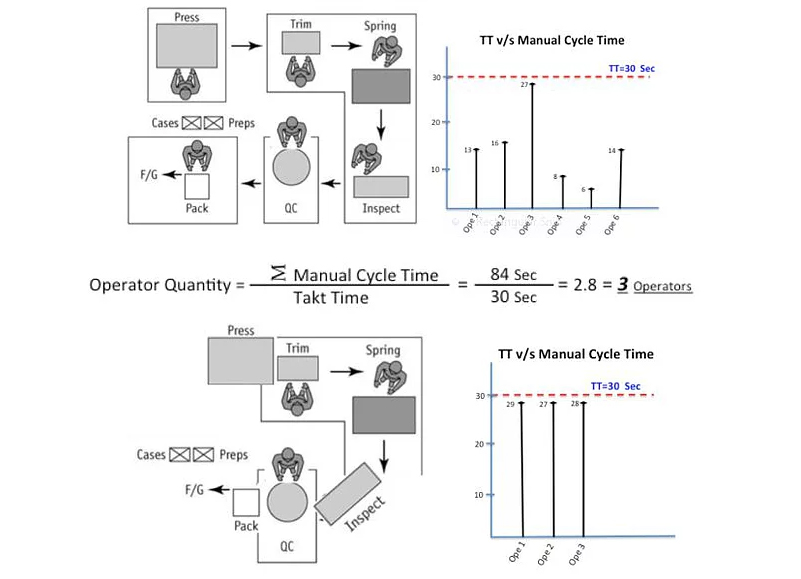
The calculation above shows that is possible to run this Manufacturing Cell with just 3 operators.

Misunderstanding 2:

There is another misunderstanding about the representation of TT, many people don’t understand this concept how to interpret and calculate the Number of Resources when they have operators working in parallel.

For example; when there are operations that are not possible to be separated, the activity must be done from the beginning to the end by one operator at time; and if the cycle time is greater than Takt Time; then you need to use more than one operator to cover the rate needed, this means to have two or more operators working in parallel, for this case the Takt Time must be different.
You should never use the average of those operators as the Manual Work Content, you need represent as it is and make the calculations using other Takt Time equivalent.

Here is a PRACTICAL EXAMPLE:
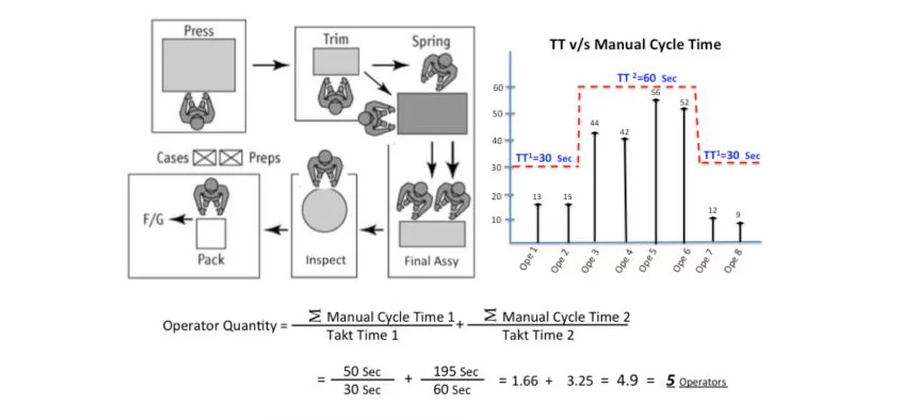

The calculation shows that is possible to run this Manufacturing Cell with just 5 operators; please note that here there is two Takt Times, but do not get confuse at the end the Cell will run at 30 Seconds of Takt Time; equivalent to 120 UPH.
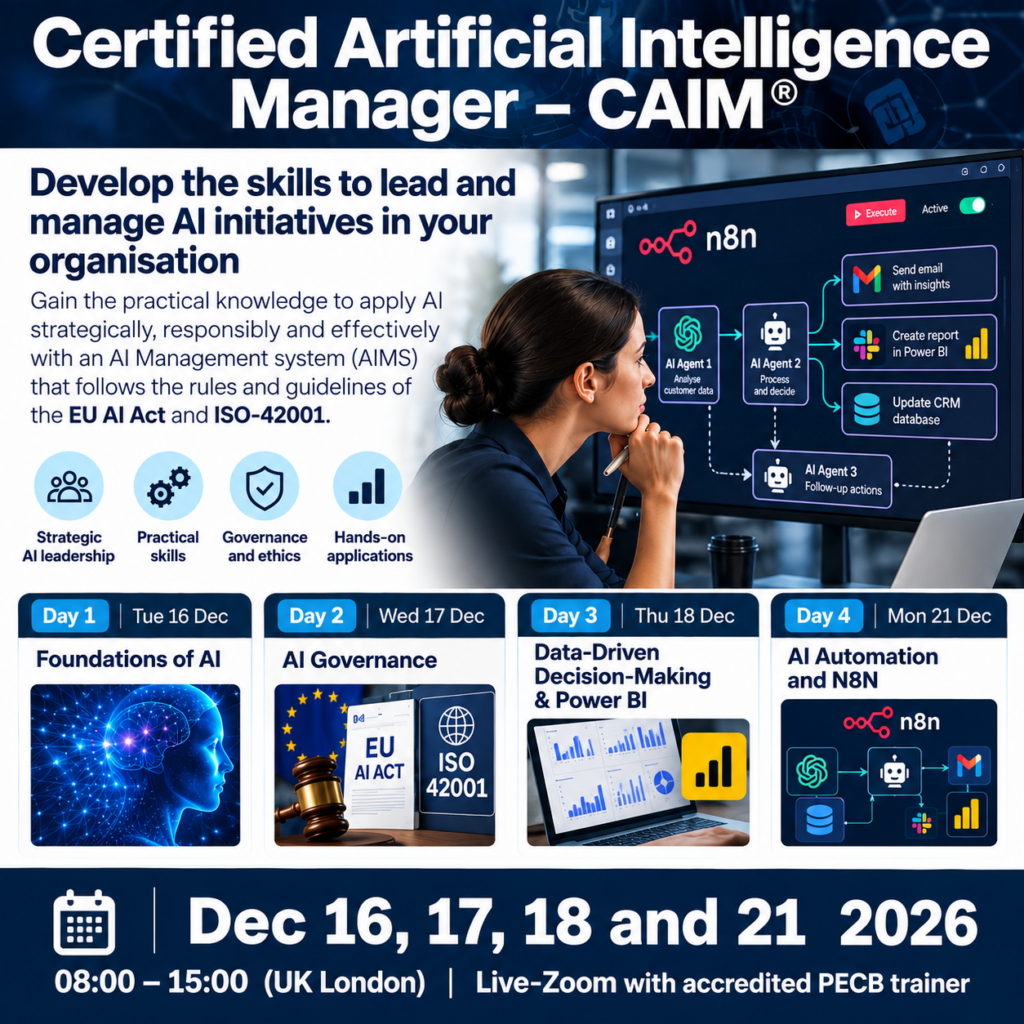
 

4-day Live-Zoom + Exam

AI Certification Manager Course CAIM PECB UK

December 16,17,18 and 21 2026 : Accredited UK Based trainer

The Certified Artificial Intelligence Manager training course enables participants to acquire the necessary expertise to manage, govern, and implement AI strategies successfully within an organization.

This course provides the essential framework for leaders to bridge the gap between complex technology and strategic business goals. It includes a broad range of domains from foundational AI concepts and global trends to advanced applications like data-driven decision-making with Power BI and workflow automation using AI agents. 

It also emphasizes responsible AI governance, including risk management, transparency, and compliance, ensuring participants are well prepared to oversee AI projects that deliver real business value.

Importantly, this course focuses on utilizing intuitive, visual platforms, allowing professionals to implement powerful solutions without the need for technical programming expertise.

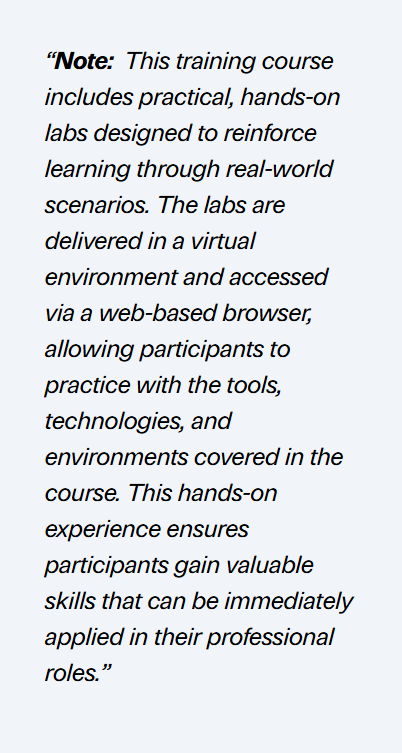
NOTE for CAIM PECB Live Zoom

Why Should You Attend?


In today’s rapidly evolving AI-driven world, the ability to manage AI initiatives is a critical leadership skill. The Certified Artificial Intelligence Manager course is your gateway to turning AI’s technical potential into governed, measurable business results. This training moves beyond high-level strategy by equipping you with practical governance frameworks and hands-on skills to plan, monitor, and automate AI solutions effectively.

Throughout this program, you will gain hands-on experience with the complete AI life cycle using accessible, no-code environments. You will learn how to assess data readiness, govern AI systems with fairness, transparency, and risk awareness, and tell compelling stories with data using Power BI. You will also explore cutting-edge automation by building AI agents through visual interfaces such as n8n. This approach allows you to focus on logic, strategy, and business outcomes rather than writing code.

After attending the training course, you can take the exam. If you pass, you can apply for the “Certified Artificial Intelligence Manager” credential. Attaining this credential demonstrates your capability to lead with confidence. This distinction confirms your competence to align AI projects with company goals, interpret complex results through interactive dashboards, and ensure compliance with evolving regulations and internal policies.

Whether you are a project manager, business director, or compliance officer, this course will empower you to:

Align AI strategies with organizational objectives to maximize ROI
Govern AI projects by mitigating risks, ensuring fairness, and maintaining compliance
Visualize performance metrics using interactive Power BI dashboards for better decision-making
Automate routine workflows by designing and deploying AI agents through user-friendly interfaces
By joining this course, you are taking a significant step toward becoming a trusted authority in AI management and ensuring your organization harnesses the power of AI safely, effectively, and in line with its strategic goals.

Prerequisites
There are no formal prerequisites for this training course. A general familiarity with business processes, data, or digital tools is helpful but not required.

Who Should Attend ?

Educational Approach

Educational Approach
The course combines strategic concepts with practical application to ensure participants master both the “why” and the “how” of AI management.


Hands-on labs and workshops use visual, drag-and-drop environments so participants can build Power BI dashboards and n8n automation flows immediately, without writing code.
Participants are strongly encouraged to interact with one another, exchange ideas, and actively participate in discussions.


PECB offers various training course delivery formats, from traditional classroom settings to modern, technology-driven solutions. To learn more about these formats, please click here.

Learning Objectives

This training course is intended for:

AI project and product managers who are responsible for planning and delivering AI in.tiatives, need to strengthen their governance skills, and communicate outcomes clearly to stakeholders


Business leaders and program directors (including transformation leaders, COOs, and department directors) who oversee AI initiatives across cross-functional teams and must ensure that technology investments support business objectives


Risk, compliance, and governance officers who review AI use cases, handle AI risk assessments and transparency reports, and ensure that the organization complies with ethical guidelines, internal policies, and external regulations


Team leaders and managers in key industries (such as health care, finance, manufacturing, and public services) who work with vendors and internal teams to ensure that AI solutions deliver tangible measurable value
IT managers, consultants, and digital transformation professionals moving into AI leadership roles who require a comprehensive understanding of AI strategy, data readiness, governance, and automation tools

By the end of this training course, participants will be able to:

Explain how AI governance, leadership, and risk management intersect, and apply the findings to support compliant and responsible operations


Align AI initiatives with organizational goals and stakeholder requirements in a strategic way to ensure clear ownership and measurable outcomes


Evaluate and prioritize AI opportunities using simple assessment tools to identify high-value, feasible projects
Design and implement interactive dashboards in Power BI


Create automated workflows by building and orchestrating AI agents directly in n8n to increase operational efficiency and consistency


Develop a structured communication and change management plan to support smooth AI adoption across teams and functions